

The Plug-and-Play Myth:
What You Were Promised vs. What You Got
If you’re building a health product, you’ve probably been told some version of this:

Why Now: Interop Isn’t Optional Anymore
New regulations like the 21st Century Cures Act are accelerating the demand for data access and exchange. And as decentralized trials and digital health tools expand, “talking to the system” isn’t a nice-to-have—it’s a survival skill.
If your product can’t interoperate with the health ecosystem—from EHRs to labs to payers—you’ll struggle to:
-
Land pilots
-
Pass compliance reviews
-
Scale across multiple sites
-
Gain investor or partner trust
The short version?
If your product doesn’t connect, it doesn’t compete.
The Real Problem: Standards ≠ Standardization
Health tech is full of technical terms that sound like they solve the problem: FHIR. HL7. SMART on FHIR. APIs.
Here’s the catch:
These are standards.
But they’re not standardized in practice.
Let’s break it down:
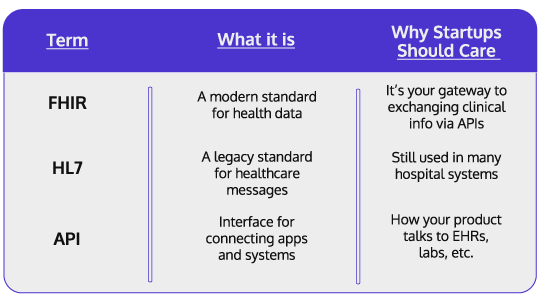
Sounds great—until you realize:
-
One EHR might expose 8 FHIR endpoints, another only 3
-
Field names may differ across systems
-
“FHIR-compatible” doesn’t mean “plug-and-play”
-
Some systems use custom rules that break your assumptions
The result?

Multiply that across systems or clinical sites, and you’re not scaling—you’re stuck.
Why Interoperability Really Matters to Startup Teams
You don’t need to be technical to feel the cost:


And most of the time, this isn’t a product problem.
It’s an infrastructure problem—caused by trying to DIY what should’ve been baked in.
What Smart Teams Are Doing Differently
Founders who are scaling past these hurdles aren’t building from scratch. They’re:

How Alternova Helps
We’ve seen this story play out over and over—brilliant product teams getting blocked by the messy, underfunded part of the stack: the part that’s supposed to just work.
That’s why we built our EHR hosting platform specifically for health startups and research teams who can’t afford to get stuck:
-
Medplum-native, fully managed infrastructure
-
SOC2-compliant, HIPAA-ready, audit-tested
-
Used in real-world integrations, not just theoretical ones
-
Support from engineers who actually know what you’re building
We make FHIR work like it’s supposed to—so your product doesn’t have to fight your platform.
TL; DR
Plug-and-play is still a myth in health tech.
Because “compliant” isn’t the same as usable, scalable, or safe.
If you’re building a health product that needs to connect across systems,
your infrastructure matters more than you think.